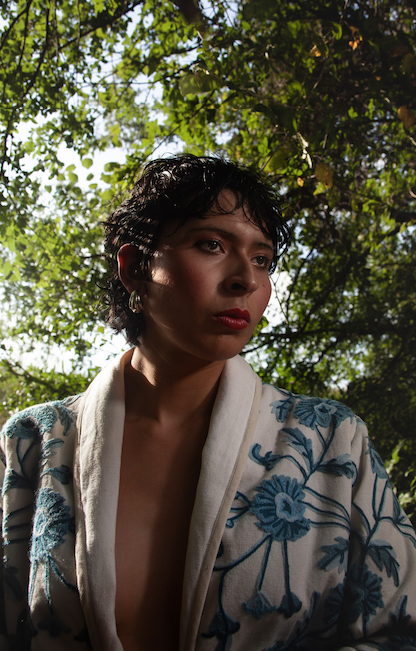
Photo by Rosei Matcek
Shout out Kim aka kimdollars1 aka kimila for yet another fire Finals piece. This time, Kim expanded the Finals universe (which I admit is increasingly New York City-centric) into the American Southwest, and sat down with musician Sewa Choki. I rely on Finals contributors to put me onto life-changing music, like Tyler did earlier this year with 1Alkebulan. Kim did not let me down. Thank you Kim and thank you Sewa Choki.
Andrew
--
The other night, I attended a local show featuring my friend Chuck Roth, who was in town touring his excellent album, watergh0st songs, from the start of this year. Also on the bill was my friend Sewa, who recently released her album She is All Around Me as Sewa Choki on American Southwest, a label headed by nudo, the Texas experimentalist duo. I’ve been a big fan of the album, which filters the Tejano canon through Sewa’s distinctive sense of rhythm and sound design, anchored by field recordings and references to Yaqui ceremonial music.
I particularly love how She Is All Around Me carries a sense of surreality that feels very tethered to the landscape of central Texas, where dust blends into rolling grass blends into rivers and forests, and the weather either lingers or lurches in ways that defy seasonality or any other temporal sense. Emotionally, it feels like the haze that comes after some sort of big reckoning, like walking into a sunny day after spending the morning crying.
A week before the show, I met up with Sewa at her apartment, where her roommates Lucía and Vio floated around as we chatted about life before meandering into this interview about the album. Afterwards, Vio, Sewa, and I sat around watching Tejano videos and interviews that Vio pulled up on the TV. Hit those hyperlinks when you get a chance, to go deeper into the world of Sewa and her cohort. Which is where we are headed right now...
You used to interview artists?
I would, kind of. Do you remember a musician named L.Cie?
I don’t know if I do… in Austin?
She’s named Chloe Scarlett now. She used to run Curiosity Shop. Now, she lives in New York. She was one of the first people I interviewed. I went to see a Curiosity Shop show. I interviewed Vio…
This was during college?
For college, yeah. In my professional life, I definitely think I want to start interviewing Tejano musicians and stuff like that.
Are there any Tejano musicians you know personally?
No, but I know of some. I think with the credibility of my job being at KUT and I have a KUT email, I can send stuff. I just need to convince my job to, like, pay for me to do that. But I think that’s really what this next year is going to be about. I’m probably going to go down to one day a week and with that, I’ll have a ton more time. I’m only part time there and I’ll just use the extra time I have to present them with things that are journalistically inclined.
Have you been writing much in any medium these days?
No, not journalism wise, but I do a lot of research. I mean, this whole album was like researching a genre and seeing who’s significant, or relevant, and all.
What are some of the genres or histories you were researching for this album?
It was a Tejano album. The thing is, I grew up knowing and learning the history of Tejano because I was raised in San Antonio, one of the Tejano capitols of Texas. My mom would literally take me to plays recreating the history and invention of Tejano music in the west side of San Antonio. San Antonio cares a lot about preserving cultural history and teaching the kids the tradition. I almost learned how to play the guitar for Tejano bands in high school, but the teachers were kinda crazy. They weren’t good teachers and then they also had this crazy, macho-man attitude about teaching children how to play instruments.
More common than you would think…
This album made me realize that is my culture and that is something special to harness. I’ve been sleeping on the fact that part of why I got into music is because I heard how beautiful these chords that these musicians were making and the melodies were. Even the accordion, I always wanted to play, I just never had the money to buy one.
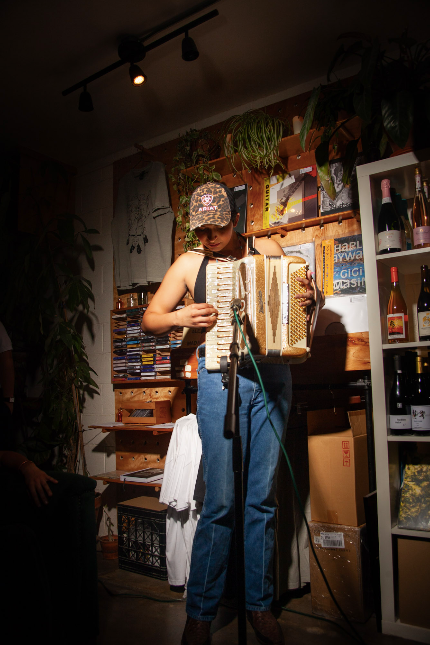 Sewa Choki live at Community Garden, 11/13/2025, photo by Rosei Matcek
Would you say you listened to a lot of Tejano growing up?
Yeah, it started with my grandpa being a huge Tejano fan and then my dad was the one who broke it down for me and was like, “These are the people who are quintessential listening.” People being, like, Steve Jordan, David Lee Garza, Emilio Navaira, just a lot of different musicians, I could name off, like, twenty. And my mom, of course, too. Both my parents loved Tejano music. I was just telling Lucia this, but I think I really got into it on my own once my grandpa died and I was trying to feel close to him. I took that as an opportunity to educate myself and talk to my dad, like, “Tell me more about this stuff.” He would give me his CDs.
Was that more recently, or when you were younger?
I was 14, probably, when I started doing the real investigative work of my own. It’s funny because at the same time, I was also reconnecting with my indigenous ancestry. Then, come to find out years later from my friends in Arizona who are Yaqui, being Yaqui and loving Tejano music go together. They’re, like, inseparable.
Were you playing music at this time?
The interest in music as something to make and do came when I was, like, 16ish. It was the summer of 2016, so I was 15 actually. What kicked it into gear was listening to, like, Prince and New Order and Tyler, the Creator, honestly. I loved the synthesizer he used. Also, my dad got me into P-Funk, like Parliament, Funkadelic, George Clinton. That changed my life as well. I would also listen to these artists like Little Joe y La Familia. It’s this really famous band, but also a band that my grandpa loved. They combined a lot of those psychedelic rock, funk elements into Tejano music. It was all coalescing for me. I didn’t want to make culturally influenced music at that point, explicitly, but I was like, “These chords are what touches my soul from Tejano music,” which came from jazz and R&B. I was like, “I wanna integrate that with this new wave sound.”
So it was an intentional choice to not have those things show up explicitly.
Yeah, I guess it was because I didn’t know how to do it. I was just really starting. I had got a MIDI keyboard and Ableton Lite, because that’s what it comes with, and I just tried to make, like, synth music. I tried to make my idea of, like, new wave, synth-pop music, synth wave, and synth funk. But yeah, all I knew was that I wanted to carry on the kind of harmonies that really inspired me from Tejano.
This is fast forwarding a lot, but what inspired you to tackle those ideas more head-on with your music now?
The whole album is about losing this great thing I had going with Crystal, with my girlfriend. At that point in time, I made a name for myself as a dance producer and DJ, but I could not bring myself to hear a dance song. It literally made me sick, especially because a lot of the things that made me not-so-great in our first relationship were tied to me breaking out into the DJ scene a little bit. Whether that was me just being kind of selfish, or drinking a lot, or thinking too highly of myself, you know, like, very not-great features of a person that bled over into my relationship. And so, yeah, I just couldn’t listen to dance music at all. Then, Tejano music, a lot of it is very simple music in terms of the lyrics. I also listen to Norteño, which is a genre that is more Mexican than Tex-Mex, but there’s a symbiotism. I would find myself listening to both Tejano and Norteño and just really feeling the lyrics. I was like, “Thank god for Tejano, because it’s just a genre about fucking up and losing a beautiful woman.” (laughs)
Totally.
That’s what it all came back to. I was so distraught, I couldn’t listen to anything else. Then I was like, “Is this it? Is this finally the time that I wake up that part of me and put it into my own art?” I think what also showed me that was possible was my friendship with Joaquin and Eric from nudo. They’re obviously, in my mind, pioneers of this Tex-Mex experimental sound that is coming out of Texas now. They showed me it was possible. Eric specifically, he knows a lot of the Tejano classics and the legends that I grew up listening to, and so he had that language and that’s what he brings to nudo. That was really inspiring for me. It made me feel very seen and I was like, “You know, I could do that too, but in my own Yaqui-fied way.”
What was the timeline of you working on the album?
The album was really made between, like, July of 2024 and the last song was probably made September 2024. I made the first few songs for my set that I played in San Francisco. I got my Digitakt 2 literally two weeks before that set. I was like, “This is on my heart. I’m just going to go for it.” It was an ambient set. I was opening for Siete Catorce and Travieza. Then, from there, I had the formula in my head.
What are the earlier tracks from the album?
The intro, for sure, Equis. Actually, there were a few songs from that set where Equis was the main one, and the other ones were kind of just lost in time. But it definitely inspired what came after. I made a set for Nite School when I got back to Austin in August. This was after me and Crystal had already gotten back together, or not gotten back together, but we had started reconnecting. It was interesting because I had these, like, two parts of the album. One was made still in the depths of that loss and grief. Then, the other half was made in this era of hope, but cautious hope, because you know asking for someone’s forgiveness, trying to show you’re a different person, is really nerve-wracking.
You can hear that in songs like Whirlpools. That was such a distinct emotion and when I would feel that emotion during that reconnection process, I would literally just go back to that song and listen. To me, it was the embodiment of this tension, and yearning, and pleading, like quiet pleading inside for someone. They’re there, but you can’t be as close to them as you want to be, and you know you shouldn’t be because of the things you’ve done. That’s what that song feels like to me. There are two sides of the album that feel very different to me.
Did that affect how you sequenced the album?
Definitely. It’s funny because Equis was the intro to the first set, and then Aatka, the second song, was the intro song to the second set. I almost thought about dropping one of them because I was like, “These both sound like intros.”
This is a bit of an artificial divide, but I feel like this album is very naturalistic in a way where I feel like a lot of stuff you do that I’ve seen in the past few years has more of a cyber edge to it. What inspired that shift in your sound? Was it an extension of everything you were talking about, or did it come from something specific as well?
I think the nature aspect is extremely tied to the subject matter. It has to do with me shedding that idea of syntheticism and, like, dance, hard dance. Part of what I was feeling that summer was when I couldn’t be near Crystal, she showed me so much of this land, and got me so familiar with it. Even though I had lived here for my whole life, I hadn’t experienced it how I did when I met her. Once she was gone, all that was left to connect to her and be near her was to be with the land. So I wanted the album and music to be another extension of me trying to be close to her, and convey this desire and anguish in trying to be close to her, and facing the repercussions of my actions, by using the literal sounds of the land.
What was the intention behind the different samples you used on the album?
All the sounds I mixed with some of my Syntakt sounds that I used in my music prior to this album, which I think was a cool way of transitioning it. I own a Yaqui hand drum that I played and sampled into the album, as well. Me and Crystal are both Yaqui, so that’s another element of this theme. The rhythms also sampled some other Yaqui traditional ceremonial music, when you hear flutes, or when you hear more of the cacophonous stuff. A lot of the kicks are me literally dropping rocks in wet sand near this place near the Colorado River – in Texas, not the Colorado River that goes in Colorado, but a different river a little outside of Austin. We went to that place together, so I went back there and found there was a bush that we had found together. This was like a month into dating. She was like, “You should sample this. This would be really cool.” Once we were finally broken up, I was like, “I’m gonna go back there and I’m gonna get these samples.” To me, that meant a lot in a lot of different ways.
Is that something you would do traditionally, more sound design type stuff like that? Like, sampling something to repurpose as a kick drum?
It was definitely new to me. Although, I have had this philosophy ever sense I started, which was I really didn’t like using presets. I felt like they were not a cop out, but like it made music a little bit more impersonal, which I’ve changed my perspective on. But that made music-making fun for me. Every sound, even if it was something as simple as a basic clap, I made it. I at least had my touch on it. That was really when I was doing a lot of my earlier dance music, not so much in high school, but more like since I’ve moved to Austin. That was like, really going into synthetic sound design and stuff, and trying to recreate even like Yaqui instruments synthetically, but that has its own range of reasons why. But I reached the point where I think the point of presets sometimes can be to, like, gesture to either a point in time, or a genre, or a place, or using specific samples too can point to that. So I used synths that invoke this feeling of 90s Tejano music, but I also had to process a lot of the samples I made to make them function in a dance music sense, and also just so they were audible in the way I needed them to be.
You told me that you got the accordion while you were writing the album, and you wrote some of the album on the accordion?
I did write it on the accordion, specifically the song Sueños de Mesquite. It’s funny though, because that song has no accordion on it.
Oh nice, but you wrote the melody on it?
Yeah, it was a cool moment, definitely. It felt like I really broke through understanding how to play it at that point. I got the accordion with intentions to record it, but I was silly and I didn’t get a good microphone to record it with and also it just didn’t have the same sound. I didn’t realize how many different kinds of accordion sounds there were, because mine is pretty “dry” is what they call it. The ones on the album have more of like a chorused effect.
If you had been going through those presets, you would’ve been like, “There’s so many accordions…”
Yeah, I tried to synthesize a good accordion and it was alright, but it just didn’t hit the same as the actual sample from the song. I ended up just using the accordions from a few Tejano songs that I would listen to repeatedly. The main motif from the album is from a song called Hay Algo en Ti, like, “There’s Something in You.” I used that at the start of the album and the end of the album. Now when I play live, I just play the melody on accordion.
How has it been adapting, now, the album back to the accordion? Have you found any challenges or idiosyncrasies in that?
It’s been really nice. I’m definitely a beginner when it comes to the accordion. I play the accordion with a keyboard. I picked it specifically because I know how to play the piano, and so it was an easier transition than a button accordion, which is, like, all the buttons are white and I don’t know what skills are involved in that. (laughs) But yeah, it’s taught me a lot and it kind of has shown me the limitations of that, because a lot of these songs are written on button accordions. You can physically do things that you can’t do on a keyboard accordion, just because all the notes are within a centimeter distance, versus a keyboard where it’s an octave away sometimes.
You can do, like, combination buttons and stuff, I’m guessing, for notes?
Yeah, and also button accordions, when you, like, pushing and pulling, there are different notes. Some things are only possible, like, when you gestures playing an accordion. That’s been a challenge. Seeing it reminds me of the limitations of my equipment, but at the same time, it’s, like, cool to try and meet the challenge, and play it like the original samples, but on different equipment.
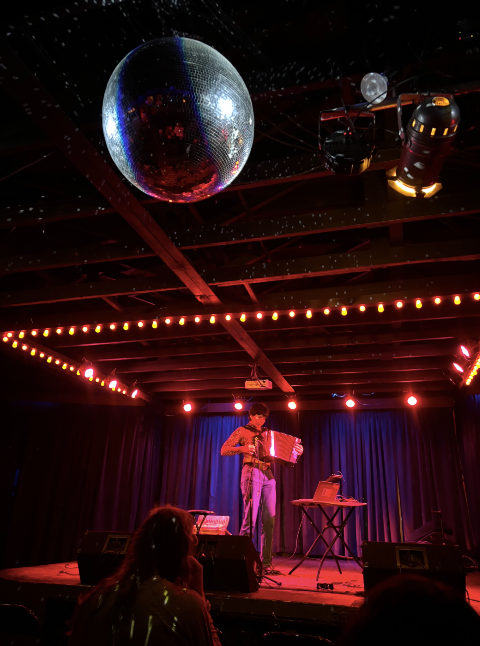 Sewa Choki live at 29th St Ballroom, with button accordion, 12/20/2025
Have you played any live sets with the accordion since the one I saw a couple of weeks ago?
Yeah, I got flown out to San Francisco and played in Oakland for a Native organization called Weaving Spirits. That was in mid-November, and that was really cool.
How was your time in Oakland?
I was staying by downtown Oakland. I was visiting my friend, and she took me to her place. It was really cool. I really like Oakland. I think it’s, like, very real, and it seems to be where a lot of the people of color are. I don’t know, the scene there just seems very cool and genuine. It was really cool seeing people walk up to the show and have this connection they didn’t realize they have. Everyone kind of knows each other and there’s a lot of Native people out there, which I appreciated a lot. I felt very seen for what I did musically out there, so I super appreciated that.
Was this the same trip you went to Sacramento?
It was.
How was your time in Sacramento?
It was cool too. I played a really cool free show for my friend Azucar, Bryant. He wanted to book me real bad out there, so when I landed, he drove me straight to Sacramento. It was really cool, and he took care of me out there. I did more of a DJ set thing that night, which was cool, but I’ve been trying to incorporate the accordion into more of my dance music sets now. I made some Tejano-like dance tracks to play that night with accordion.
Have you been breaking those out since?
Yeah, I played one the other night at Body Mechanics.
That’s fire. And you had the accordion out there?
Oh no, that would be sick (laughs). But it was just the sample. It seems like that’s what I’m getting known for. I don’t think a lot of people are busting out accordions these days, which is cool to be the person who is, like, “Hey y’all, remember this instrument?”
It gets a bad rep, you know.
It’s like, this is what this instrument has always been to me, like, Tejano, and now I’m getting into Zydeco as well, which is a New Orleans dance genre that had a lot of influence on Tejano music. If you listen to them side by side, you hear a lot of similar blues scales and stuff, and the way they use pentatonic scales. It had a lot of influence on tejano music and they’re both accordion genres.
Tejano is a really interesting genre. I don’t know a ton about it. I was at this place in San Antonio, Janie’s, a couple weeks ago. I feel like there’s a lot of disparate influences just because of the disparate nature of America and also Texas itself has a lot of, like, disparate influences. There’s a lot of cultural paths that have come through here.
A lot of people from Tejano are from the Valley, and so a lot of it is also very borderlands music as well. It has those cultural clashes, which is very beautiful to me. When I think of American music, I think of jazz, and R&B, and blues, and Black music. That to me is the Tex-American-ness of it. Then the Mex is, like, the polkas, and that’s from German/Czech background as well, but yeah, and the lyrics of course, the singing. To me, that clash is really beautiful.
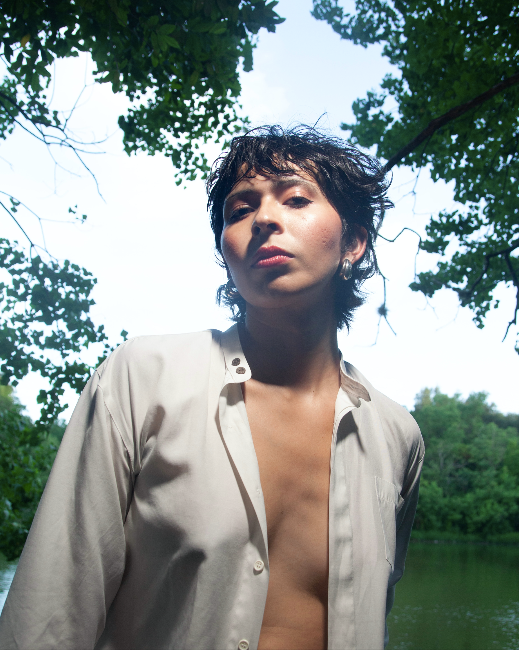 Photo by Rosei Matcek
How are you feeling about the new year?
I’m really excited to keep pushing my sound forward. I think this album felt like a huge jump for me, like a huge leap of faith. I felt like I had gotten used to this version of myself that was really poppy and synthetic, like we were saying. I kept asking people, “Would you know that I made this, or could you believe that I made this?” Everyone was like, “Yeah.” They were saying it was all in the rhythm, even if the synths were different, even if all that stuff was different. That made me feel a little bit more confident. The reception to the album has also been very encouraging, like, damn, okay, like, I have something here. If I want to keep pushing it further, then I think whatever I want to do will be received okay. That’s giving me the motivation, not that I would go back on it if there wasn’t that good reception. But it’s nice to know that I can do what I want to do. I have a lot of plans for where to go after this.
Comments
Leave a Comment